So, where does a World Cup winner go after spending eight years shaping the next generation at one of England’s top academies? Well, straight to the heart of German football, apparently.
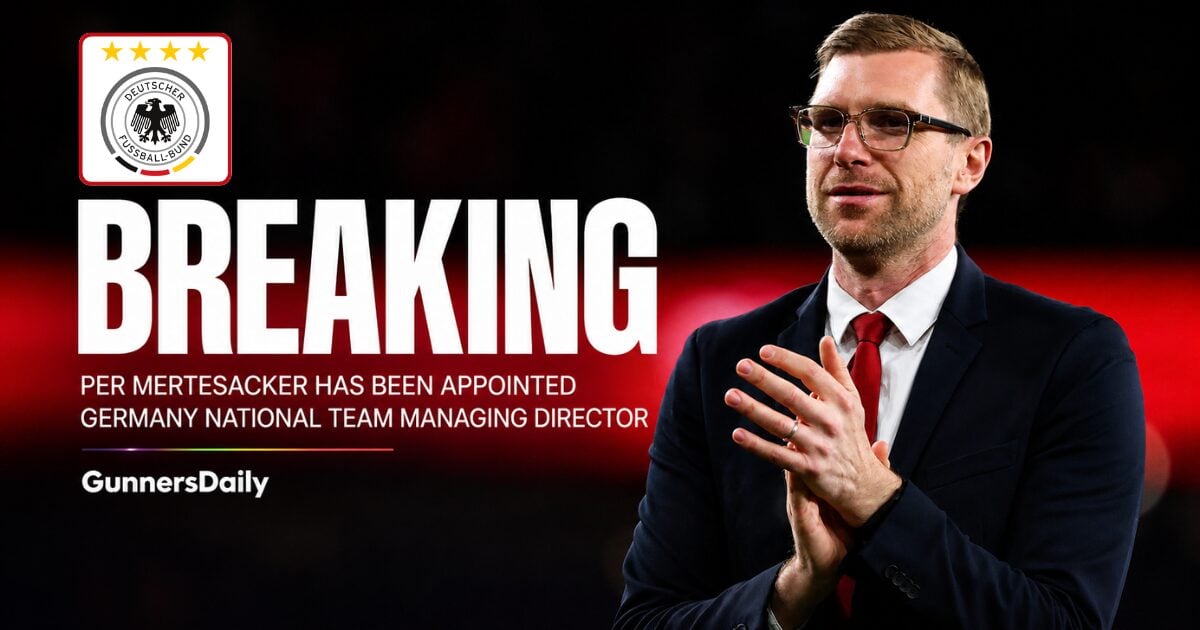
Per Mertesacker has officially been appointed as Managing Director for Sport at the German Football Association (DFB). The 41-year-old replaces Andreas Rettig and has signed a deal running through to the 2030 FIFA World Cup.
It’s a blockbuster move. And it didn’t come out of nowhere.
From Hale End Hero to DFB Decision-Maker
Mertesacker hung up his boots in 2018 after seven years at Arsenal. Rather than walking away, he took charge of the club’s Hale End Academy — a role he’d hold for the next eight years.
The results speak for themselves:
- Bukayo Saka matured into an England international under his watch
- Ethan Nwaneri became the youngest player in Arsenal’s history to debut
- Myles Lewis-Skelly earned a senior England call-up
- Max Dowman emerged as the next big Hale End prospect
Myles Lewis-Skelly recently credited Mertesacker with shaping him as a person, not just a footballer. That says a lot about the man’s approach.
Arsenal’s academy went from promising to elite under his guidance. Sky Sports described his tenure as one that produced first-team talent “in waves” — Saka and Smith Rowe first, then Nwaneri and Lewis-Skelly, and now Dowman and Marli Salmon.
When Mertesacker announced his departure in January 2026, it stung. Arsenal replaced him with Pascal De Maesschalck, formerly of Strasbourg.
But everyone sensed the DFB would come calling. And they were right.
Why Germany Needs Him Right Now
Here’s the uncomfortable truth for German football fans. Their national team hasn’t won a major trophy since 2014. They crashed out in the group stage at the 2018 and 2022 World Cups. And in 2026? A painful Round of 32 exit to Paraguay on penalties.
Julian Nagelsmann stepped down afterward. Jurgen Klopp has since been appointed as the new head coach, bringing his trademark intensity back to German football.
Mertesacker slots in alongside Klopp and sporting director Rudi Voller. His official start date is January 1, 2027, giving Rettig time to hand over responsibilities.
His remit is wide. He’ll oversee:
- All men’s and women’s national teams at senior and youth level
- The DFB Academy and long-term player development strategy
- The bridge between grassroots football and the senior squad
DFB president Bernd Neuendorf reportedly pushed hard for this appointment. Some German outlets claim contact between the two parties stretches back 18 months.
What Mertesacker Himself Had to Say
The man didn’t hold back on his excitement.
“I am very much looking forward to this new task and the responsibility that comes with it,” he said. “My connection to the DFB never broke off, even after the end of my national team career. That’s why it’s something special for me to return in this role.”
He also struck a patient, grounded tone — a hallmark of his personality.
“German football has enormous potential. With humility, the will to work hard, and the necessary patience, we want to foster the talents and personalities who make the difference.”
It’s the kind of long-term thinking that served him so well at Arsenal. No shortcuts, no flashy promises. Just steady, deliberate work.
Can he replicate that success on a national scale? That’s the million-euro question. But with 104 caps, a World Cup winner’s medal, and eight years of proven development work behind him, few candidates looked stronger.
For Arsenal fans, it’s bittersweet. They lose a club legend who quietly built something special at Hale End. For German football, it feels like the right person at the right time — someone who understands what it takes to develop winners from the ground up.
The Klopp-Mertesacker partnership could define the next era of German football. And it all started at a little academy in north London.